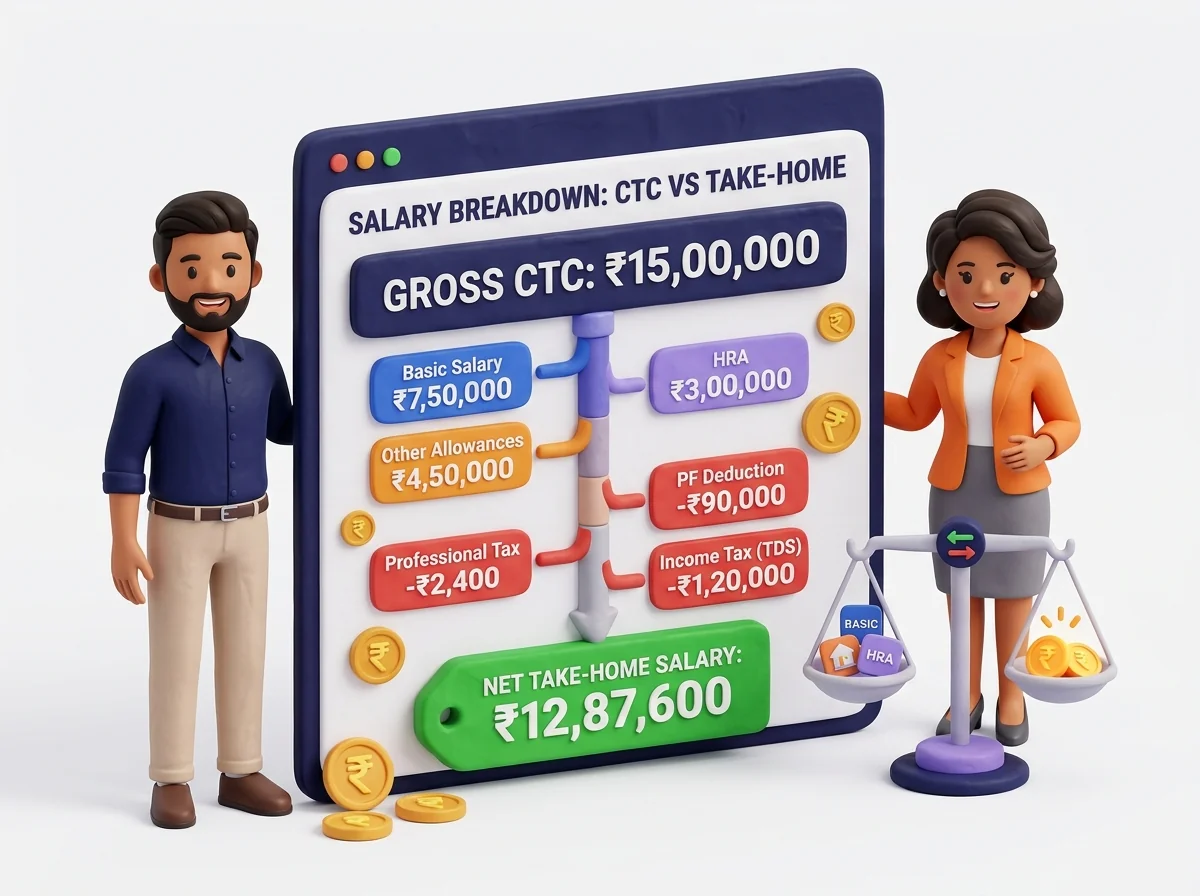
CTC to Take-Home Salary Calculator
Enter your annual package and statutory preferences to view your gross salary, employer cost burden, and net monthly bank credit.
Ordinary resident salary estimate, CTC up to ₹50 lakh; no surcharge or special-rate income.
Estimated Monthly Bank Credit
New Tax RegimeNet Monthly In-Hand (Take-Home)
₹ 0
Annual Net Take-Home: ₹ 0
Salary Component Breakdown
How Is Take-Home Salary Calculated from CTC in India?
CTC is the employer’s total cost. Gross salary excludes employer-side PF, ESI and the illustrative gratuity provision. Take-home is gross salary minus employee PF, ESI, PT and estimated TDS. Insurance, variable pay and other components in an actual offer can change the result.
CTC vs Gross vs In-Hand Salary: What Goes Where?
A clear line-by-line distinction between total employer expenditure, pre-tax gross pay, and net credited bank amount.
Cost to Company (CTC)
The total annual expense an employer budgets for an employee. It combines gross pay with behind-the-scenes statutory contributions that you never receive directly in your paycheck.
Gross Monthly Salary
The total direct earnings reflected on your monthly payslip before deducting employee taxes or personal statutory savings contributions.
Net In-Hand (Take-Home)
The actual liquid cash wired to your bank account every month after subtracting employee statutory contributions and tax withholding.
Illustrative salary examples
New regime, resident under 60, Basic 50%, metro HRA illustration, capped PF, Maharashtra general category, no other deductions. PT shown as annual average; rounded only for display.
| Annual CTC | Basic Pay (50%) | Gross Monthly | Employee Deductions | Monthly In-Hand | Annual In-Hand % |
|---|---|---|---|---|---|
| ₹4,00,000 | ₹16,667/mo | ₹30,732/mo | ₹2,008/mo | ₹28,724/mo | 86.2% of CTC |
| ₹6,00,000 | ₹25,000/mo | ₹46,998/mo | ₹2,008/mo | ₹44,990/mo | 90.0% of CTC |
| ₹12,00,000 | ₹50,000/mo | ₹95,796/mo | ₹2,008/mo | ₹93,788/mo | 93.8% of CTC |
| ₹25,00,000 | ₹1,04,167/mo | ₹2,01,525/mo | ₹26,780/mo | ₹1,74,745/mo | 83.9% of CTC |
Statutory Components & Rules Explained
How Indian labour laws and tax codes determine every rupee on your salary slip.
💰 Monthly Earnings
Basic pay and wage definition
Set the basic percentage to match your offer. The statutory wage definition uses specified exclusions and a 50% add-back test; it is not a universal Basic = 50% of CTC rule. This calculator does not determine the legal wage base.
House Rent Allowance (HRA)
Typically 50% of Basic for metro cities (Delhi, Mumbai, Kolkata, Chennai) or 40% for non-metros. Partial or full tax exemption can be claimed in the Old Tax Regime under Section 10(13A).
Special Allowance
A fully taxable residual component used as a balancing plug to reach the agreed gross salary after setting Basic and HRA.
📉 Monthly Employee Deductions
Provident Fund (EPF & EPS - 12%)
The model assumes 12% employee and employer PF, optionally capped at ₹15,000 of monthly PF wages. Actual coverage and contributory wages require employer verification.
Employee State Insurance (ESI - 0.75%)
The estimate uses employee 0.75% and employer 3.25% for covered wages within ₹21,000. It assumes 30 days for the low daily-wage employee exemption; contribution-period continuation and special categories are not modelled.
Professional Tax (PT - State Level)
State-levied employment tax constitutionally capped at ₹2,500/year under Article 276. Most active states deduct ₹200/month.
Income Tax (TDS - FY 2026-27)
New regime uses ₹75,000 standard deduction, 4/8/12/16/20/24 lakh slab boundaries, eligible resident rebate up to ₹12 lakh taxable income, marginal relief just above it and 4% cess. No special-rate income is included.
Calculation notes
Assumptions and review scope
Designed & Engineered by: AccoNova
Technical Implementation Note: A useful salary estimate separates employer costs, gross wages and employee deductions. Review the selected wage base, membership and tax assumptions before comparing the estimate with a payslip.
How this public salary estimate works
A simplified model for comparing an offer; it does not certify a payroll run.
Configurable Basic allocation
Basic defaults to 50% as an illustration. Check the legal wage definition separately.
Dynamic Special Allowance Balancing
Accurately absorbs remaining CTC funds into taxable special allowance after employer PF, Gratuity, and ESI obligations.
FY 2026-27 Dual Tax Slabs
New-regime slab boundaries: ₹4/8/12/16/20/24 lakh, followed by 30%; eligible rebate and marginal relief are applied before 4% cess.
Multi-State PT & ESIC Rules
MH, KA and Telangana salary PT profiles are available; other jurisdictions require a verified annual amount. Confirm ESI membership and period rules.
Frequently Asked Questions
Common questions regarding CTC offer letters, take-home salary calculations, and tax deductions in India.
Why is take-home lower than CTC?
CTC may include employer contributions, gratuity provisions, insurance and variable pay. Employee contributions and tax are then deducted from gross wages. Check the components of your actual offer.
Does the law require Basic to equal 50% of CTC?
No. The wage definition includes an add-back test for specified exclusions above 50% of remuneration. Basic, statutory wages and CTC are different concepts; this calculator uses an adjustable illustration.
When is new-regime salary tax nil?
In this ordinary-salary resident model, the eligible rebate applies up to ₹12 lakh taxable income. With only a ₹75,000 standard deduction, gross salary of ₹12.75 lakh produces nil tax. This is not a ₹12.75 lakh CTC exemption or a rule for special-rate income.
What deductions does the old-regime estimate include?
Only the ₹50,000 standard deduction, employee PF within the ₹1.5 lakh eligible investment cap and entered annual PT. HRA exemption, other investments and 80D require a separate calculation.
Is the gratuity provision a monthly deduction?
The illustration includes a 15/26/12 provision against basic pay as an employer cost. Actual entitlement depends on wages, service and applicable law, including exceptions to service-length requirements.
Why can actual PT differ each month?
The salary estimate spreads annual PT over 12 months. Maharashtra and Karnataka can require ₹300 in February, and some local bodies assess half-yearly. Use the PT calculator and relevant authority schedule for payroll.
Expert Teardowns: CTC Breakdown, Take-Home Maximization & TDS 2026
CTC vs In-Hand Salary Structure & Tax Saving Guide
Complete breakdown of employer PF, gratuity accruals, standard deductions, and the 50% basic wage Code on Wages threshold.
TDS on Salary Calculator FY 2026-27 (Section 115BAC)
Section 115BAC revised tax slabs, rebate up to ₹12.75 Lakh under the new regime, surcharge rates, and monthly TDS withholding rules.