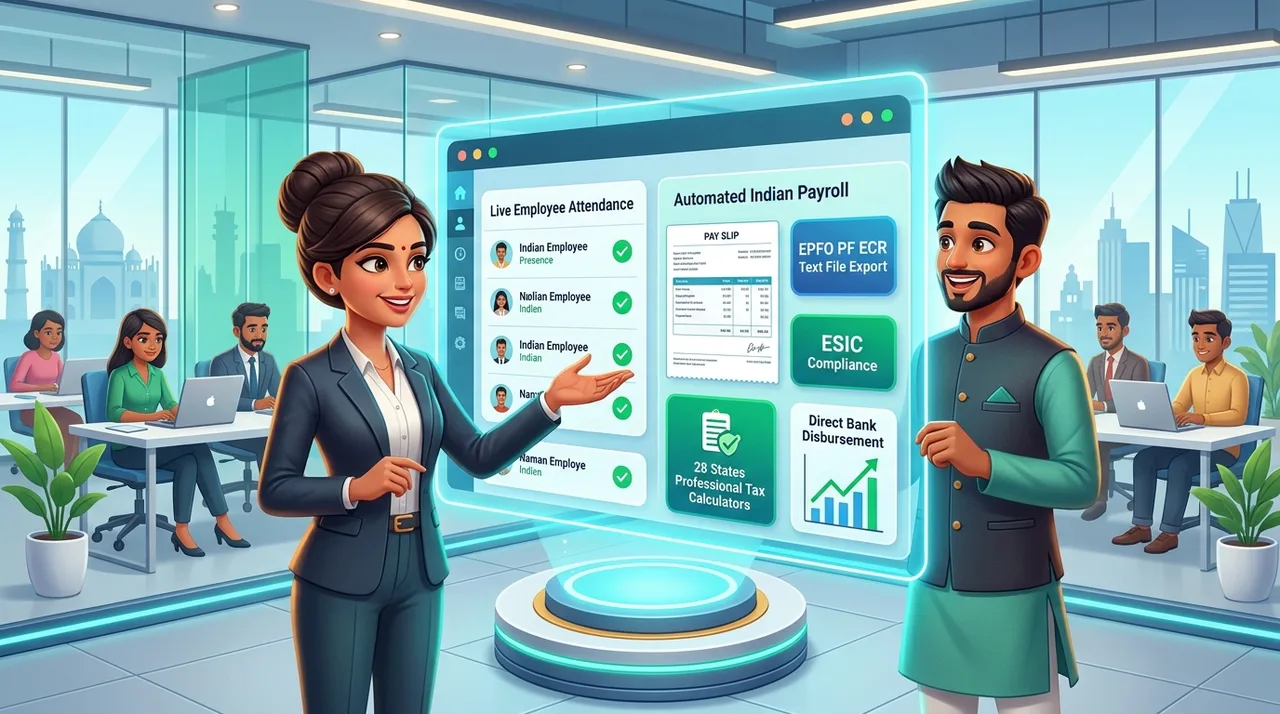
AccoNova vs. Keka vs. greytHR vs. Legacy Spreadsheets
Use this vendor-authored checklist with current quotes and your own demo. Checked 30 September 2026; unverified competitor claims are marked for confirmation. See the detailed comparison page for official vendor links.
| Feature / Evaluation Dimension | AccoNova HRMS | Keka HR | greytHR | Excel / Spreadsheets |
|---|---|---|---|---|
| Free plan | View current plans | Verify with vendor | Verify with vendor | Check licence and operating costs |
| Pricing model | Published tiers and employee buffer rates | Verify with vendor | Verify with vendor | Include maintenance and review effort |
| Onboarding | Depends on data and configuration | Verify with vendor | Verify with vendor | Validate templates and opening data |
| EPF ECR export | Confirm plan; validate on the current portal | Verify with vendor | Verify with vendor | Validate format and totals |
| Professional tax | Check supported jurisdiction and rule version | Verify with vendor | Verify with vendor | Maintain jurisdiction-specific rules |
| Data protection | Review security and DPA disclosures | Verify with vendor | Verify with vendor | Review access and sharing settings |
| Mobile workflow | Responsive web / PWA | Verify with vendor | Verify with vendor | Test your actual device and workflow |
Want to see how your current software or spreadsheet stacks up? Run a live parallel test with AccoNova today.
Compare Pricing Plans →The 25-Point HRMS Vendor Evaluation Framework
Evaluating HRMS and payroll software in India requires looking beyond slick marketing demos. To protect your organization from statutory penalties, payroll leakage, and vendor lock-in, use this structured 25-point procurement scorecard across six critical evaluation pillars.
Pillar 1: Core HR & Employee Lifecycle Management
Foundational digital employee record-keeping and organizational hierarchy.
Employee Record Management & Digital Vault
Does the system maintain comprehensive digital profiles, document vaults for Aadhaar/PAN/agreements, and asset allocations?
Centralizing verified records eliminates misplaced compliance documents and streamline audits.
Onboarding & Offboarding Workflows
Self-service digital onboarding forms, document upload verification, resignation workflows, and no-dues clearance checklists.
Manual onboarding takes 3–5 days per hire; automated self-onboarding reduces HR involvement to minutes.
Role-Based Access Control (RBAC)
Granular permission boundaries separating Super Admin, HR Admin, Payroll Admin, Branch Manager, and Employee.
Prevents salary confidentiality breaches and ensures branch managers only access their direct team data.
Audit Logs & Historical Traceability
Immutable timestamped logs capturing who created, modified, or deleted employee, attendance, or salary records.
Essential for financial audits, dispute resolution, and regulatory compliance under the DPDP Act 2023.
Pillar 2: Time, Attendance & Workforce Mobility
Verification mechanisms that prevent time theft while accommodating diverse workplace modes.
Multi-Modal Attendance Capture
Support for mobile GPS geo-fencing, tablet kiosk mode with selfie verification, and biometric device integration.
Indian businesses with field sales, factory shifts, and office teams require versatile capture methods.
Shift Rostering & Rota Management
Rotational shift patterns, night shift allowances, automated break deductions, and shift-swap approvals.
Manufacturing, healthcare, and 24/7 retail operations fail when shift schedules cannot handle dynamic changes.
Overtime & Late Mark Automation
Configurable grace periods, automated half-day deductions for repeated late marks, and overtime approval workflows.
Manual attendance collation takes days and introduces payroll disputes; rules must apply automatically.
Leave Policy & Statutory Accrual Engine
Support for Casual Leave (CL), Paid Leave (PL/EL), Sick Leave (SL), Maternity Leave, carry-forward caps, and encashment.
Leave balances directly affect monthly payroll loss of pay (LOP) and final settlement liabilities.
Pillar 3: Automated Indian Payroll & Statutory Compliance
The core compliance engine preventing severe financial and legal penalties.
Automated Monthly Payroll Engine
Single-click salary computation accounting for attendance, leaves, LOP, reimbursements, loan deductions, and bonuses.
Eliminates Excel errors, duplicate salary payouts, and multi-day payroll processing delays.
Direct EPFO ECR Text File Export
Native generation of the #~# delimited ECR text file ready for direct upload to the EPFO Unified Portal without manual formatting.
EPFO rejects improperly formatted files, leading to delayed PF deposits and penal damages under Section 14B.
ESIC Slabs & Half-Yearly Form 6 Reporting
Automatic application of the ₹21,000 gross wage threshold, 0.75% employee and 3.25% employer contributions, and monthly return sheets.
Wage spikes due to incentives can alter ESI applicability mid-period; the engine must handle wage limits accurately.
Multi-State Professional Tax (PT) Slabs
Built-in tax slab logic for all Work-states and UTs with automatic adjustment for February spikes (e.g. Maharashtra ₹300).
Multi-branch companies face state tax notices when employees are taxed under incorrect regional slabs.
Income Tax (TDS) & Form 16 Part A/B Compilation
Automated tax calculation under both Old and New Tax Regimes (Section 115BAC), proof verification, and bulk Form 16 PDFs.
Quarterly 24Q filing and annual Form 16 issuance are mandatory employer liabilities under the Income-tax Act.
Full & Final (FnF) Settlement & Gratuity Calculation
Automated computation of unbilled salary, leave encashment, notice period pay, gratuity (Payment of Gratuity Act), and recovery deductions.
Labour laws mandate timely FnF payout; manual calculations frequently result in labour commissioner disputes.
Bank Payout Export & NEFT/RTGS Batch Files
Export of bank-specific salary payout files (HDFC, ICICI, SBI, Axis formats) for bulk net-pay disbursement.
Direct batch upload eliminates manual account-by-account bank transfers and transfer typo risks.
Pillar 4: Security, Data Privacy & Infrastructure
Enterprise defense standards protecting employee PII and business financial records.
Indian Data Residency & Cloud Infrastructure
AccoNova uses access controls and protected connections to support HR data handling. Request applicable security and processing disclosures through the contact page; infrastructure configuration is not published.
Ensures compliance with national data governance policies and guarantees low-latency access for domestic users.
Encryption at Rest & In Transit
TLS 1.3 encryption for web and mobile transport, paired with AES-256 encryption at rest for documents and databases.
Protects sensitive employee salary, bank, and Aadhaar numbers from man-in-the-middle and storage theft.
DPDP Act 2023 Compliance Readiness
Digital consent capture during onboarding, right-to-correction workflows, and data retention policy controls.
The Digital Personal Data Protection Act imposes substantial penalties for unauthorized employee data processing.
Pillar 5: User Experience & Mobility
Adoption drivers that determine whether staff and managers actually use the system.
Employee Self-Service (ESS) Mobile Experience
Intuitive mobile-responsive browser/PWA interface allowing employees to view payslips, punch attendance, and submit tax proofs.
High ESS adoption reduces HR support queries by up to 70% and accelerates approvals.
Manager Self-Service (MSS) & Approval Workflows
Multi-level approval chains for leaves, attendance regularizations, expense reimbursements, and shift adjustments.
Prevents operational bottlenecks when team leads can approve requests directly from mobile notifications.
Integrated AI & Automated Helpdesk
Built-in AI assistant for HR policy queries, automated ticket routing, and conversational document lookup.
Answers routine employee questions instantly without burdening the core HR team.
Pillar 6: Commercial Transparency, Migration & Support
Contractual safeguards ensuring smooth implementation and predictable long-term costs.
Transparent Pricing & Buffer Capacity
Clear pricing tiers with built-in user buffer capacity rather than aggressive penalties for temporary headcount spikes.
Many legacy vendors quote low base fees but impose steep per-user overage charges during seasonal hiring.
Data Migration & Spreadsheet Onboarding Support
Standardized Excel/CSV import templates for employee master data, past salary history, and opening leave balances.
A failed or protracted migration stalls payroll operations and creates severe employee dissatisfaction.
Data Portability & Zero Vendor Lock-In
Ability to export complete employee master data, historical payslip archives, and attendance logs in standard formats at any time.
Guarantees business continuity and prevents a vendor from holding your company's statutory records hostage.
Customer Support Channels & SLA Response Times
Direct ticketing, email support, and dedicated account managers with contractual SLA response times during payroll cut-off days.
A software bug on the 30th of the month must be resolved within hours to prevent payroll delays.
Transparent Plans for Every Growth Stage
Compare current plan amounts, employee limits and included modules on the pricing page before choosing your subscription.
Evaluating Enterprise Architecture & Governance?
For technical leaders, CTOs, and IT directors seeking a deep-dive into cloud tenancy, DPDP Act 2023 compliance, and API integration specifications.
Frequently Asked Questions for HR Software Buyers
How long does a typical HRMS implementation take for an Indian SME?
With standardized Excel import templates, most Indian businesses with 20 to 200 employees can complete employee master setup, leave policy configuration, and attendance geo-fencing in 24 to 72 hours. Running parallel payroll for one month alongside existing spreadsheets is recommended to verify calculations.
Can we switch HRMS software mid-financial year without disrupting Form 16?
Yes. Ensure the software supports Year-to-Date (YTD) salary imports. AccoNova HRMS allows importing prior monthly gross earnings, PF deductions, and tax withholdings so that annual Form 16 Part B certificates accurately reflect the entire financial year.
What is the difference between buffer pricing and strict per-user pricing?
Strict per-user pricing charges extra for every additional hire immediately, often requiring contract renegotiations. Buffer pricing provides a predefined capacity band (e.g., base of 50 users with capacity up to 75 at predictable incremental rates), accommodating seasonal hiring spikes without contract friction.
Does AccoNova provide an EPFO-compliant ECR text file directly?
Yes. AccoNova generates the official #~# delimited text file formatted strictly according to the EPFO Unified Portal specification, including UAN, gross wages, EPF wages, EPS wages, and contribution breakdowns.