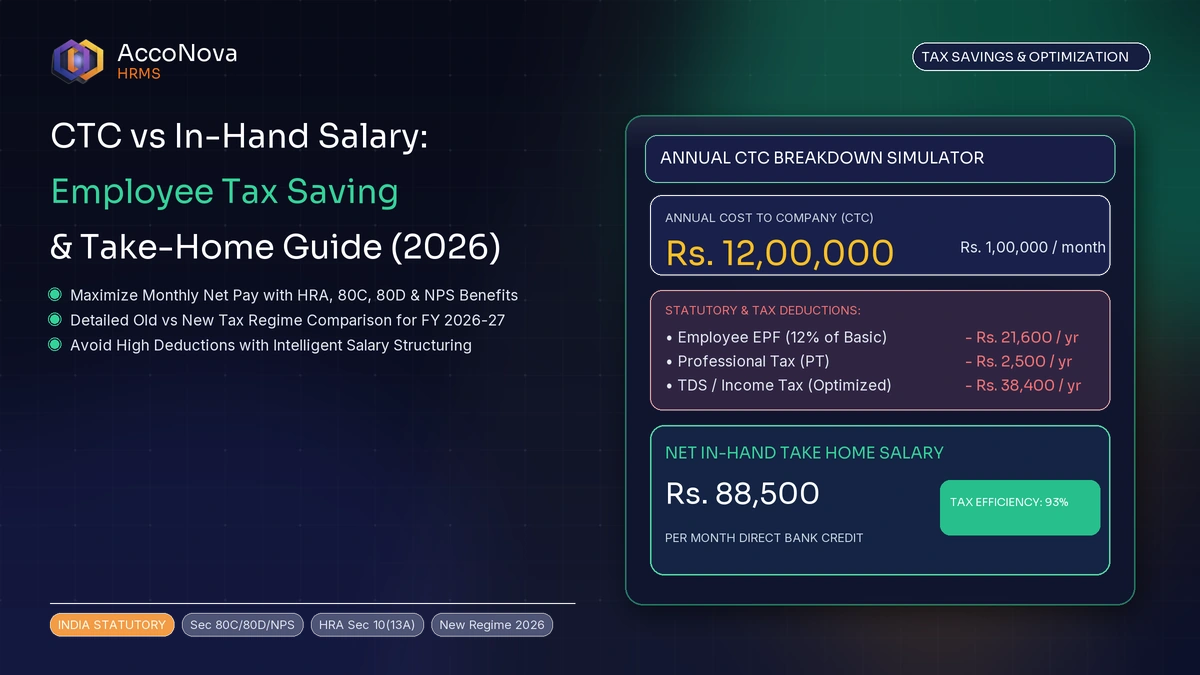
Master guide to CTC vs in-hand salary calculations, monthly take-home deductions (EPF, PT, TDS), Code on Wages 50% rule, and salary structuring templates.
Quick Summary (TL;DR): Cost to Company (CTC) is the total annual expenditure an employer spends on an employee, whereas In-Hand (Net Take-Home) salary is the actual amount credited to the employee’s bank account each month. CTC includes employer-side statutory contributions (12% Employer PF, 3.25% Employer ESI, gratuity accrual, and group insurance) that are never paid out directly in monthly cash. Under the Code on Wages 2019 framework, employers must ensure specified exclusions (HRA, conveyance, special allowances) do not exceed 50% of total remuneration, or the excess automatically adds back to the wage base for PF and Gratuity. For FY 2026-27 under the New Tax Regime (Section 115BAC), employees with a gross taxable salary up to ₹12.75 Lakh incur zero net income tax due to the Section 87A rebate.
Receiving a job offer with an attractive CTC is exciting, but many employees face disappointment when their first monthly payslip arrives with a significantly lower bank credit than expected. Similarly, Indian HR directors, founders, and finance leaders face the challenge of structuring compensation packages that maximize employee take-home pay while strictly complying with the Code on Wages and avoiding punitive EPFO audits.
This master guide bridges both perspectives by explaining the mathematical architecture between CTC, Gross Salary, and Net Take-Home pay for professionals, while detailing compliant salary band design for employers.
The 3 Distinct Layers of Salary Architecture
To calculate your actual take-home pay, an offer letter must be broken down into three distinct financial layers:
┌────────────────────────────────────────────────────────────────────────┐
│ 1. Cost to Company (CTC) = Gross Salary + Employer Benefits/Provisions │
└──────────────────────────────────┬─────────────────────────────────────┘
                                   │ Subtract: Employer PF, Gratuity, Insurance
                                   ▼
┌────────────────────────────────────────────────────────────────────────┐
│ 2. Gross Salary = Basic + HRA + Special Allowance + Other Earnings     │
└──────────────────────────────────┬─────────────────────────────────────┘
                                   │ Subtract: Employee PF, Professional Tax, TDS
                                   ▼
┌────────────────────────────────────────────────────────────────────────┐
│ 3. Net Take-Home Salary = Actual Monthly Credit to Bank Account        │
└────────────────────────────────────────────────────────────────────────┘- Layer 1: Annual Cost to Company (CTC): The total financial cost incurred by the employer. It incorporates direct cash payments plus indirect statutory benefits (employer PF share, gratuity reserves, group medical insurance premiums, and deferred performance bonuses).
- Layer 2: Monthly Gross Salary: The earnings before employee-side deductions. This includes Basic Pay, House Rent Allowance (HRA), Special Allowance, and other fixed allowances.
- Layer 3: Net Take-Home Pay (In-Hand): Gross salary minus employee statutory deductions: Employee Provident Fund (12%), Professional Tax (₹200/month in most states), and monthly TDS (income tax withholding).
Employee Calculation Example: ₹12 Lakh Annual CTC (FY 2026-27)
Below is a detailed, real-world salary breakdown for an employee receiving a ₹12,00,000 annual CTC offer based in a metro city under standard statutory capping:
A. Annual CTC Breakdown (Employer Cost)
| Salary Component | Annual Amount (₹) | Monthly Amount (₹) | Component Classification |
|---|---|---|---|
| Basic Salary (50%) | ₹6,00,000 | ₹50,000 | Core taxable wage base |
| House Rent Allowance (HRA - 40%) | ₹2,40,000 | ₹20,000 | Exemption available in Old Regime |
| Special Allowance | ₹2,55,500 | ₹21,292 | Fully taxable balancing allowance |
| Gross Salary Subtotal | ₹10,95,500 | ₹91,292 | Direct Cash Earnings |
| Employer EPF Contribution (Capped) | ₹21,600 | ₹1,800 | 12% of capped ₹15,000 basic |
| Statutory Gratuity Provision (15/26) | ₹28,860 | ₹2,405 | Deferred retirement benefit reserve |
| Group Medical Insurance Premium | ₹14,040 | ₹1,170 | Corporate health coverage benefit |
| Total Annual CTC | ₹12,00,000 | ₹1,00,000 | Total Employer Expenditure |
B. Monthly Take-Home Deductions
From the Gross Salary of ₹91,292 per month, the following employee deductions apply:
- Employee EPF (12% of ₹15,000 capped): ₹1,800 / month
- Professional Tax (Maharashtra / Karnataka): ₹200 / month (₹300 in Feb; deductible under Section 16(iii))
- Income Tax (TDS) under FY 2026-27 New Regime: ₹0 / month
Why ₹0? Gross taxable salary of ₹10,95,500 minus the ₹75,000 standard deduction leaves ₹10,20,500. Under the FY 2026-27 New Tax Regime, taxable income up to ₹12 Lakh qualifies for the full Section 87A rebate, resulting in zero net tax liability.
$$\text{Monthly Net Take-Home} = ₹91,292 - (₹1,800 + ₹200) = \mathbf{₹89,292 \text{ per month}}$$
Key Insight: An annual CTC of ₹12,00,000 translates to an in-hand credit of ₹89,292 per month, not ₹1,00,000. The ₹10,708 monthly difference is distributed into your retirement PF corpus (₹3,600 total PF), gratuity provision, health insurance, and state tax.
New Tax Regime vs. Old Tax Regime: Which Yields Higher Take-Home?
For FY 2026-27, choosing between the New Tax Regime (Section 115BAC) and the Old Tax Regime significantly alters monthly take-home:
- New Tax Regime (Default):
- Standard deduction of ₹75,000.
- Section 87A tax rebate for taxable income up to ₹12,00,000, resulting in zero tax on gross salaries up to ₹12.75 Lakh.
- Zero requirement to lock funds in Section 80C investments (PPF, ELSS) or provide rent receipts.
- Old Tax Regime:
- Standard deduction of ₹50,000.
- Allows itemized deductions: Section 80C (up to ₹1.5 Lakh), Section 80D health insurance (up to ₹25,000 to ₹50,000), Section 24 home loan interest (up to ₹2 Lakh), and Section 10(13A) HRA exemption.
- When to choose: Only beneficial if your total eligible exemptions and deductions exceed ₹3.75 Lakh per year. You can compare both with our TDS on Salary Calculator.
Practical Tips for Employees to Maximize Take-Home Pay
- Opt for Statutory EPF Capping: If your employer allows it, contributing PF on the statutory ceiling of ₹15,000 (₹1,800/month) rather than your uncapped full basic pay increases immediate monthly in-hand cash by several thousand rupees.
- Claim Tax-Free Reimbursements: Meal cards (up to ₹50/meal), fuel reimbursement for official travel, and internet allowances reduce gross taxable pay under compliant company policies.
- Check Gratuity Deductions: Ensure your employer does not deduct gratuity from your monthly gross pay. Gratuity is exclusively an employer cost provision and must never appear as an employee-side salary deduction (estimate legal liability with our Gratuity Calculator).
The Code on Wages “50% Wage Rule” for Employers
For Indian HR directors, founders, and finance heads, designing compensation structures is a critical operational task. Structuring salary with excessively low basic pay to artificially maximize take-home cash exposes the enterprise to severe statutory audit notices from the EPFO, ESIC, and labour courts.
The unified definition of “Wages” under Section 2(y) of the Code on Wages, 2019 establishes:
1. What Counts as Core Wages?
- Basic Salary
- Dearness Allowance (DA)
- Retaining Allowance (if applicable)
2. What Is Excluded from Wages?
Permitted exclusions include:
- House Rent Allowance (HRA)
- Conveyance Allowance / Travelling Allowance
- Statutory Bonus under the Payment of Bonus Act
- Overtime Allowance
- Employer PF and Pension contributions
- Gratuity provisions
- Commission and medical reimbursements
3. The 50% Cap on Exclusions (The Add-Back Rule)
The Statutory Rule: If the total sum of all excluded allowances exceeds 50% of the employee’s total remuneration, the excess amount over 50% is treated as part of “Wages” and added back to the wage base for calculating PF and Gratuity.
Practical Takeaway: While the law does not state “Basic must equal 50% of CTC,” keeping Basic Pay at approximately 40% to 50% of Gross Salary ensures that total exclusions stay within the 50% threshold, preventing automatic statutory add-backs and recalculation disputes.
Recommended 5-Pillar Employer Salary Structure
Below is an optimal, audit-resilient salary structure template designed for modern Indian employers:
| Component | Recommended Allocation (% of Gross) | Statutory Rationale | Tax Treatment |
|---|---|---|---|
| Basic Salary | 40% to 50% | Anchors EPF, Gratuity, and statutory bonus calculations. Minimum wage laws apply. | Fully taxable |
| House Rent Allowance (HRA) | 40% (Non-Metro) / 50% (Metro) of Basic | Complies with standard Indian income tax limits. | Exemption eligible under Sec 10(13A) in Old Regime |
| Statutory Bonus Provision | Minimum 8.33% of Basic | Complies with Payment of Bonus Act for eligible wage bands. | Taxable in year of payment |
| Special / Balancing Allowance | 15% to 25% | Absorbs remaining salary budget without creating additional statutory liabilities. | Fully taxable |
| Employer Statutory Overhead (Over Gross) | Approx. 13% of EPF wages + 4.81% Gratuity | 12% PF (A/c 1 & 10) + 0.5% Admin + 0.5% EDLI + Gratuity reserve. | Fully deductible corporate business expense |
Full Employer CTC Reconciliation Model: ₹10 Lakh Package
To illustrate how employer cost reconciles to candidate compensation, examine this ₹10,00,000 CTC engineering model:
1. Direct Cash Components (Gross Pay):
- Basic Pay (50% of Gross): ₹4,56,500 / year (₹38,042 / month)
- HRA (40% of Basic): ₹1,82,600 / year (₹15,217 / month)
- Special Allowance: ₹2,73,900 / year (₹22,825 / month)
- Annual Gross Salary: ₹9,13,000 / year (₹76,083 / month)
2. Employer-Side Statutory Benefits & Provisions:
- Employer EPF (Capped at ₹15k wage base): ₹21,600 / year (₹1,800 / month)
- Employer EPF Admin & EDLI (1%): ₹1,800 / year (₹150 / month)
- Statutory Gratuity Accrual (15/26 of Basic): ₹21,947 / year (₹1,829 / month)
- Group Term Life & Health Insurance Premium: ₹12,000 / year (₹1,000 / month)
- Annual Employer Benefit Total: ₹57,347 / year
3. Annual Performance Bonus Reserve:
- Annual Discretionary Variable Bonus: ₹29,653 / year
- Total Cost to Company (CTC): $₹9,13,000 + ₹57,347 + ₹29,653 = \mathbf{₹10,00,000}$
5 Critical Rules Before Releasing Offer Letters
- Never Show Gratuity as a Monthly Employee Deduction: Gratuity is an employer accrual reserve under the Payment of Gratuity Act, 1972. Deducting gratuity from an employee’s gross monthly pay violates the Payment of Wages Act.
- Reconcile Minimum Wage Notifications: Ensure that Basic + DA meets or exceeds the notified state minimum wage for the specific skill category (Unskilled, Semi-Skilled, Skilled, Highly Skilled) in that work location.
- Disclose Variable Pay Terms in Writing: Clearly state payout frequency (annual/quarterly), clawback provisions, and whether active employment on the payment date is an eligibility requirement.
- Clarify Capped vs. Uncapped EPF Policy: State explicitly in the appointment letter whether the organization contributes PF on the statutory ceiling of ₹15,000 or on actual uncapped basic pay.
- Standardize Salary Bands in HRMS: Avoid custom manual one-off CTC calculations that drift into non-compliance by maintaining structured templates.
Automating Compensation Governance with AccoNova HRMS
AccoNova’s compensation and payroll engine eliminates spreadsheet errors:
- Salary Band Templates: Create standardized CTC templates enforcing the 50% basic rule across executive, managerial, and junior tiers.
- Automated Offer Letter Generator: Pulls directly from configured salary bands, rendering compliant offer letters with clear component tables.
- Direct Payroll & Tax Sync: Instantly seeds new hire packages into monthly payroll, managing Section 115BAC tax calculations automatically.
Model compensation bands with our free CTC Calculator, draft monthly employee statements with the Salary Slip / Payslip Generator, calculate long-term retirement savings with our EPF Calculator, verify state tax rules on our Professional Tax Calculator and State-Wise Professional Tax Guide, integrate shift punches via Attendance Tracking Software, or explore enterprise payroll capabilities on our Payroll Management Software and HRMS Platform Features pages.
Sources & Reference Links
Last source check: 11/10/2026. Scope and assumptions are stated in the article. Check later amendments before filing.