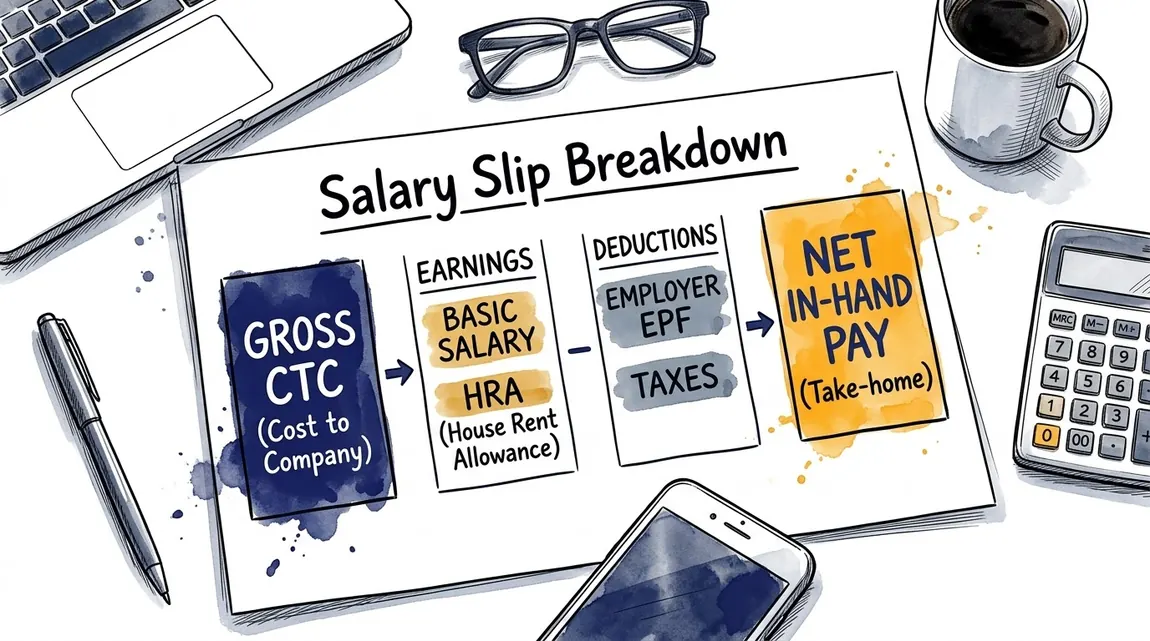
Step-by-step employer and employee guide on how to calculate TDS on salary for FY 2026-27 using Section 115BAC slabs, standard deduction, and Section 87A rebate.
Quick Summary (TL;DR): Under Section 192 of the Income-tax Act, employers must deduct Tax Deducted at Source (TDS) from employee salary payments on an estimated average monthly basis. For FY 2026-27, the default tax regime is the New Tax Regime (Section 115BAC). With a flat standard deduction of ₹75,000 and the Section 87A rebate covering taxable income up to ₹12 Lakh, an employee earning an annual gross salary of up to ₹12.75 Lakh incurs zero net tax liability. For earnings exceeding this threshold, tax applies progressively across revised slab boundaries with a 4% Health and Education Cess.
Estimating annual ordinary-salary income tax and calculating accurate monthly TDS deductions is a vital payroll responsibility for Indian employers and an essential financial check for employees. This guide breaks down the statutory rules, deduction steps, and calculations for Financial Year 2026-27 (Assessment Year 2027-28).
Interactive TDS Calculation Model
Estimate your annual ordinary-salary income tax and illustrative monthly TDS deduction under FY 2026-27 rules below:
(Note: For instant multi-regime comparisons with itemized Chapter VI-A deductions and HRA exemptions, use our dedicated TDS on Salary Calculator).
Statutory Tax Framework for FY 2026-27
The Income-tax Act 2025, amended by Finance Act 2026 provides the governing rules in sections 19, 156, and 192.
Step-by-Step New Tax Regime (Section 115BAC) Calculation:
- Apply Standard Deduction: Deduct the flat standard deduction of ₹75,000 from gross salary earnings.
- Compute Slab Tax: Apply progressive tax rates at the revised ₹4/8/12/16/20/24 Lakh taxable-income boundaries:
- ₹0 to ₹4,00,000: Nil (0%)
- ₹4,00,001 to ₹8,00,000: 5%
- ₹8,00,001 to ₹12,00,000: 10%
- ₹12,00,001 to ₹16,00,000: 15%
- ₹16,00,001 to ₹20,00,000: 20%
- ₹20,00,001 to ₹24,00,000: 25%
- Above ₹24,00,000: 30%
- Apply Section 87A Resident Tax Rebate: For resident individuals whose net taxable income does not exceed ₹12,00,000, the full tax amount (up to ₹60,000) is rebated, reducing net tax to zero.
- Marginal Relief Just Above ₹12 Lakh: If taxable income slightly exceeds ₹12 Lakh, marginal relief ensures that the tax payable does not exceed the income earned above ₹12 Lakh.
- Add 4% Health and Education Cess: Add 4% cess to the computed tax.
- Monthly TDS Withholding: Divide the net annual tax liability by the number of remaining pay periods in the fiscal year to determine the monthly TDS deduction.
Worked Example: ₹15 Lakh Gross Salary
At ₹15,00,000 gross salary:
- Standard Deduction: ₹75,000
- Taxable Income: ₹14,25,000
- Slab Tax Calculation:
- Up to ₹4L: ₹0
- ₹4L to ₹8L (5% of ₹4L): ₹20,000
- ₹8L to ₹12L (10% of ₹4L): ₹40,000
- ₹12L to ₹14.25L (15% of ₹2.25L): ₹33,750
- Total Pre-Cess Tax: ₹93,750
- 4% Cess: ₹3,750
- Total Annual Tax Liability: ₹97,500
- Monthly Average TDS: ₹8,125 per month
Critical Tax Thresholds & Old vs New Regime Comparison
At ₹12,00,000 taxable ordinary income, the Section 87A rebate reduces tax liability to zero. Because salaried individuals receive the ₹75,000 standard deduction, any employee earning up to ₹12,75,000 gross salary pays ₹0 tax under the New Tax Regime.
Under the Old Tax Regime:
- Standard deduction is ₹50,000.
- Tax rebate applies only up to ₹5,00,000 taxable income.
- To match the tax savings of the New Regime for salaries above ₹12 Lakh, an employee requires eligible itemized deductions (Section 80C, 80D, Section 24 home loan interest, and Section 10(13A) HRA) exceeding ₹3.75 Lakh to ₹4 Lakh.
- Use our HRA Exemption Calculator and TDS on Salary Calculator to compare your personalized net numbers.
From Annual Tax to Monthly Payroll Withholding
Section 192 requires employers to adjust monthly withholding as tax declarations are verified throughout the year:
- Mid-year joining dates and previous employer earnings (Form 12B).
- Actual investment proof submissions in Q4.
- Performance bonuses or variable payouts that shift taxable brackets.
Automate TDS & Payroll Compliance with AccoNova
- Check your exact monthly take-home salary using our free TDS on Salary Calculator.
- Model compensation packages with the CTC to In-Hand Salary Calculator and our CTC vs In-Hand Salary Guide.
- Generate payslips reflecting exact TDS withholding with our Salary Slip / Payslip Generator.
- Explore full statutory automation on our Payroll Management Software and HRMS Platform Features pages.
Sources & Reference Links
Last source check: 11/10/2026. Scope and assumptions are stated in the article. Check later amendments before filing.