Quick Summary (TL;DR): Structuring an employee compensation package in India requires balancing total employer cost (Cost to Company - CTC) with competitive take-home pay and strict statutory compliance. Under the Code on Wages framework, employers must navigate the statutory definition of “wages,” ensuring that specified exclusions (HRA, conveyance, overtime, special allowance) do not exceed 50% of total remuneration. When exclusions exceed 50%, the excess amount automatically adds back to the wage base for calculating Provident Fund (PF), Gratuity, and ESI contributions. Designing compliant salary bands protects organizations against retroactive statutory liabilities while offering clarity to candidates.
For Indian HR directors, founders, and finance heads, designing compensation structures is a complex engineering task. Structuring salary with excessively low basic pay to maximize take-home cash may appear attractive to candidates, but it exposes the enterprise to severe statutory audit notices from the EPFO, ESIC, and labour courts.
Here is the complete employer’s guide to architecting compliant, transparent, and tax-efficient salary structures in India.
The Code on Wages “50% Wage Rule” Demystified
The most discussed compliance reform in Indian compensation design is the unified definition of “Wages” under Section 2(y) of the Code on Wages, 2019:
1. What Counts as Core Wages?
Core wages include:
- Basic Salary
- Dearness Allowance (DA)
- Retaining Allowance (if applicable)
2. What Is Excluded from Wages?
Permitted exclusions include:
- House Rent Allowance (HRA)
- Conveyance Allowance / Travelling Allowance
- Statutory Bonus under the Payment of Bonus Act
- Overtime Allowance
- Employer PF and Pension contributions
- Gratuity provisions
- Commission and medical reimbursements
3. The 50% Cap on Exclusions (The Add-Back Rule)
The Statutory Rule: If the total sum of all excluded allowances exceeds 50% of the employee’s total remuneration, the excess amount over 50% is treated as part of “Wages” and added back to the wage base for calculating PF and Gratuity.
Practical Takeaway: While the law does not state “Basic must equal 50% of CTC,” keeping Basic Pay at approximately 40% to 50% of Gross Salary ensures that total exclusions stay within the 50% threshold, preventing automatic statutory add-backs and recalculation disputes.
Recommended 5-Pillar Employer Salary Structure
Below is an optimal, audit-resilient salary structure template designed for modern Indian employers:
| Component | Recommended Allocation (% of Gross) | Statutory Rationale | Tax Treatment |
|---|---|---|---|
| Basic Salary | 40% to 50% | Anchors EPF, Gratuity, and statutory bonus calculations. Minimum wage laws apply. | Fully taxable |
| House Rent Allowance (HRA) | 40% (Non-Metro) / 50% (Metro) of Basic | Complies with standard Indian income tax limits. | Exemption eligible under Sec 10(13A) in Old Regime |
| Statutory Bonus Provision | Minimum 8.33% of Basic | Complies with Payment of Bonus Act for eligible wage bands. | Taxable in year of payment |
| Special / Balancing Allowance | 15% to 25% | Absorbs remaining salary budget without creating additional statutory liabilities. | Fully taxable |
| Employer Statutory Overhead (Over Gross) | Approx. 13% of EPF wages + 4.81% Gratuity | 12% PF (A/c 1 & 10) + 0.5% Admin + 0.5% EDLI + Gratuity reserve. | Fully deductible corporate business expense |
Full Employer CTC Reconciliation Model: ₹10 Lakh Package
To illustrate how employer cost reconciles to candidate compensation, examine this ₹10,00,000 CTC engineering model:
1. Direct Cash Components (Gross Pay):
- Basic Pay (50% of Gross): ₹4,56,500 / year (₹38,042 / month)
- HRA (40% of Basic): ₹1,82,600 / year (₹15,217 / month)
- Special Allowance: ₹2,73,900 / year (₹22,825 / month)
- Annual Gross Salary: ₹9,13,000 / year (₹76,083 / month)
2. Employer-Side Statutory Benefits & Provisions:
- Employer EPF (Capped at ₹15k wage base): ₹21,600 / year (₹1,800 / month)
- Employer EPF Admin & EDLI (1%): ₹1,800 / year (₹150 / month)
- Statutory Gratuity Accrual (15/26 of Basic): ₹21,947 / year (₹1,829 / month)
- Group Term Life & Health Insurance Premium: ₹12,000 / year (₹1,000 / month)
- Annual Employer Benefit Total: ₹57,347 / year
3. Annual Performance Bonus Reserve:
- Annual Discretionary Variable Bonus: ₹29,653 / year
- Total Cost to Company (CTC): $₹9,13,000 + ₹57,347 + ₹29,653 = \mathbf{₹10,00,000}$
5 Critical Rules Before Releasing Offer Letters
- Never Show Gratuity as a Monthly Employee Deduction: Gratuity is an employer accrual reserve under the Payment of Gratuity Act, 1972. Deducting gratuity from an employee’s gross monthly pay violates the Payment of Wages Act.
- Reconcile Minimum Wage Notifications: Ensure that Basic + DA meets or exceeds the notified state minimum wage for the specific skill category (Unskilled, Semi-Skilled, Skilled, Highly Skilled) in that work location.
- Disclose Variable Pay Terms in Writing: Clearly state payout frequency (annual/quarterly), clawback provisions, and whether active employment on the payment date is an eligibility requirement.
- Clarify Capped vs. Uncapped EPF Policy: State explicitly in the appointment letter whether the organization contributes PF on the statutory ceiling of ₹15,000 or on actual uncapped basic pay.
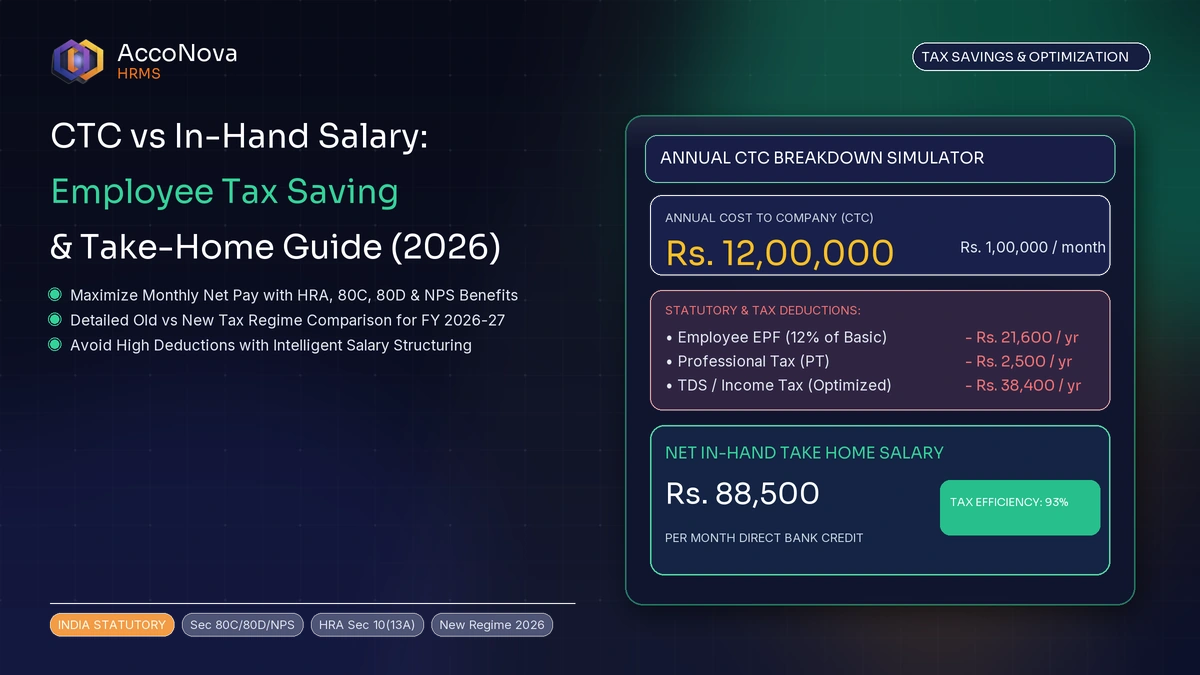
- Looking from an Employee’s Perspective? If you are an employee calculating your bank take-home, explore our CTC vs In-Hand Salary Employee Guide.
Automating Compensation Governance with AccoNova HRMS
AccoNova’s compensation and payroll engine eliminates spreadsheet errors:
- Salary Band Templates: Create standardized CTC templates enforcing the 50% basic rule across executive, managerial, and junior tiers.
- Automated Offer Letter Generator: Pulls directly from configured salary bands, rendering beautiful, compliant offer letters with clear component tables.
- Direct Payroll & Tax Sync: Instantly seeds new hire packages into monthly payroll, managing Section 115BAC tax calculations automatically.
Model compensation bands with our free CTC Calculator, check state tax rules on our Professional Tax Calculator, or explore enterprise payroll capabilities on our Payroll Management Software page.