Quick Summary (TL;DR): Cost to Company (CTC) is the total annual expenditure an employer spends on an employee, whereas In-Hand (Net Take-Home) salary is the actual amount credited to the employee’s bank account each month. CTC includes employer-side statutory contributions (12% Employer PF, 3.25% Employer ESI, gratuity accrual, and group health insurance) that are never paid out directly in monthly cash. For FY 2026-27 under the New Tax Regime (Section 115BAC), employees with a gross taxable salary up to ₹12.75 Lakh (₹12 Lakh taxable income + ₹75,000 standard deduction) incur zero net income tax due to the Section 87A rebate.
Receiving a job offer with an attractive CTC is exciting, but many employees face disappointment when their first monthly payslip arrives with a significantly lower bank credit than expected.
Understanding the mathematical gap between CTC, Gross Salary, and Net Take-Home pay empowers professionals to negotiate salary structures effectively and choose the optimal tax regime.
The 3 Distinct Layers of Salary Architecture
To calculate your actual take-home pay, an offer letter must be broken down into three distinct financial layers:
┌────────────────────────────────────────────────────────────────────────┐
│ 1. Cost to Company (CTC) = Gross Salary + Employer Benefits/Provisions │
└──────────────────────────────────┬─────────────────────────────────────┘
                                   │ Subtract: Employer PF, Gratuity, Insurance
                                   ▼
┌────────────────────────────────────────────────────────────────────────┐
│ 2. Gross Salary = Basic + HRA + Special Allowance + Other Earnings     │
└──────────────────────────────────┬─────────────────────────────────────┘
                                   │ Subtract: Employee PF, Professional Tax, TDS
                                   ▼
┌────────────────────────────────────────────────────────────────────────┐
│ 3. Net Take-Home Salary = Actual Monthly Credit to Bank Account        │
└────────────────────────────────────────────────────────────────────────┘- Layer 1: Annual Cost to Company (CTC): The total financial cost incurred by the employer. It incorporates direct cash payments plus indirect statutory benefits (employer PF share, gratuity reserves, group medical insurance premiums, and deferred performance bonuses).
- Layer 2: Monthly Gross Salary: The earnings before employee-side deductions. This includes Basic Pay, House Rent Allowance (HRA), Special Allowance, and other fixed allowances.
- Layer 3: Net Take-Home Pay (In-Hand): Gross salary minus employee statutory deductions: Employee Provident Fund (12%), Professional Tax (₹200/month in most states), and monthly TDS (income tax withholding).
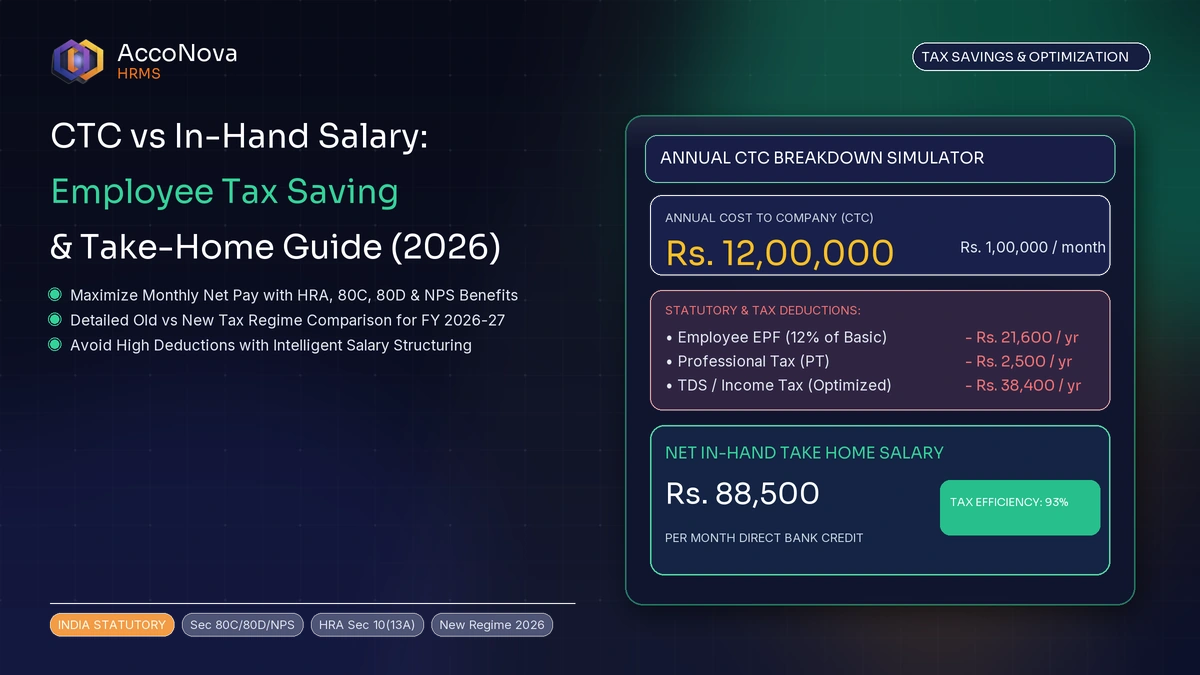
Complete Calculation Example: ₹12 Lakh Annual CTC (FY 2026-27)
Below is a detailed, real-world salary breakdown for an employee receiving a ₹12,00,000 annual CTC offer based in a metro city under standard statutory capping:
A. Annual CTC Breakdown (Employer Cost)
| Salary Component | Annual Amount (₹) | Monthly Amount (₹) | Component Classification |
|---|---|---|---|
| Basic Salary (50%) | ₹6,00,000 | ₹50,000 | Core taxable wage base |
| House Rent Allowance (HRA - 40%) | ₹2,40,000 | ₹20,000 | Exemption available in Old Regime |
| Special Allowance | ₹2,55,500 | ₹21,292 | Fully taxable balancing allowance |
| Gross Salary Subtotal | ₹10,95,500 | ₹91,292 | Direct Cash Earnings |
| Employer EPF Contribution (Capped) | ₹21,600 | ₹1,800 | 12% of capped ₹15,000 basic |
| Statutory Gratuity Provision (15/26) | ₹28,860 | ₹2,405 | Deferred retirement benefit reserve |
| Group Medical Insurance Premium | ₹14,040 | ₹1,170 | Corporate health coverage benefit |
| Total Annual CTC | ₹12,00,000 | ₹1,00,000 | Total Employer Expenditure |
B. Monthly Take-Home Deductions
From the Gross Salary of ₹91,292 per month, the following employee deductions apply:
- Employee EPF (12% of ₹15,000 capped): ₹1,800 / month
- Professional Tax (Maharashtra / Karnataka): ₹200 / month (₹300 in Feb)
- Income Tax (TDS) under FY 2026-27 New Regime: ₹0 / month
Why ₹0? Gross taxable salary of ₹10,95,500 minus the ₹75,000 standard deduction leaves ₹10,20,500. Under the FY 2026-27 New Tax Regime, taxable income up to ₹12 Lakh qualifies for the full Section 87A rebate, resulting in zero net tax liability.
$$\text{Monthly Net Take-Home} = ₹91,292 - (₹1,800 + ₹200) = \mathbf{₹89,292 \text{ per month}}$$
Key Insight: An annual CTC of ₹12,00,000 translates to an in-hand credit of ₹89,292 per month, not ₹1,00,000. The ₹10,708 monthly difference is distributed into your retirement PF corpus (₹3,600 total PF), gratuity provision, health insurance, and state tax.
New Tax Regime vs. Old Tax Regime: Which Yields Higher Take-Home?
For FY 2026-27, choosing between the New Tax Regime (Section 115BAC) and the Old Tax Regime significantly alters monthly take-home:
- New Tax Regime (Default):
- Standard deduction of ₹75,000.
- Section 87A tax rebate for taxable income up to ₹12,00,000, resulting in zero tax on gross salaries up to ₹12.75 Lakh.
- Zero requirement to lock funds in Section 80C investments (PPF, ELSS) or provide rent receipts.
- Old Tax Regime:
- Standard deduction of ₹50,000.
- Allows itemized deductions: Section 80C (up to ₹1.5 Lakh), Section 80D health insurance (up to ₹25,000–₹50,000), Section 24 home loan interest (up to ₹2 Lakh), and Section 10(13A) HRA exemption.
- When to choose: Only beneficial if your total eligible exemptions and deductions exceed ₹3.75 Lakh per year.
4 Practical Tips to Maximize Take-Home Salary
- Opt for Statutory EPF Capping: If your employer allows it, contributing PF on the statutory ceiling of ₹15,000 (₹1,800/month) rather than your uncapped full basic pay increases immediate monthly in-hand cash by several thousand rupees.
- Leverage Tax-Free Reimbursements: Meal cards (up to ₹50/meal), fuel reimbursement for official travel, and internet allowances reduce gross taxable pay under compliant company policies.
- Check Gratuity Deductions: Ensure your employer does not deduct gratuity from your monthly gross pay. Gratuity is exclusively an employer cost provision and must never appear as an employee-side salary deduction.
- Disambiguate Intent for Business Owners: If you are an HR manager designing compensation structures for your organization, review our dedicated Employer Salary Structuring & CTC Design Guide.
Test Your Numbers with AccoNova Free Tools
- Estimate your take-home pay with our interactive CTC to In-Hand Salary Calculator.
- Calculate your long-term retirement savings with our EPF Calculator.
- View state-specific deduction rates on our State-Wise Professional Tax Guide.
- Discover how automated payroll manages Old vs New Tax Regimes on our Payroll Management Software page.