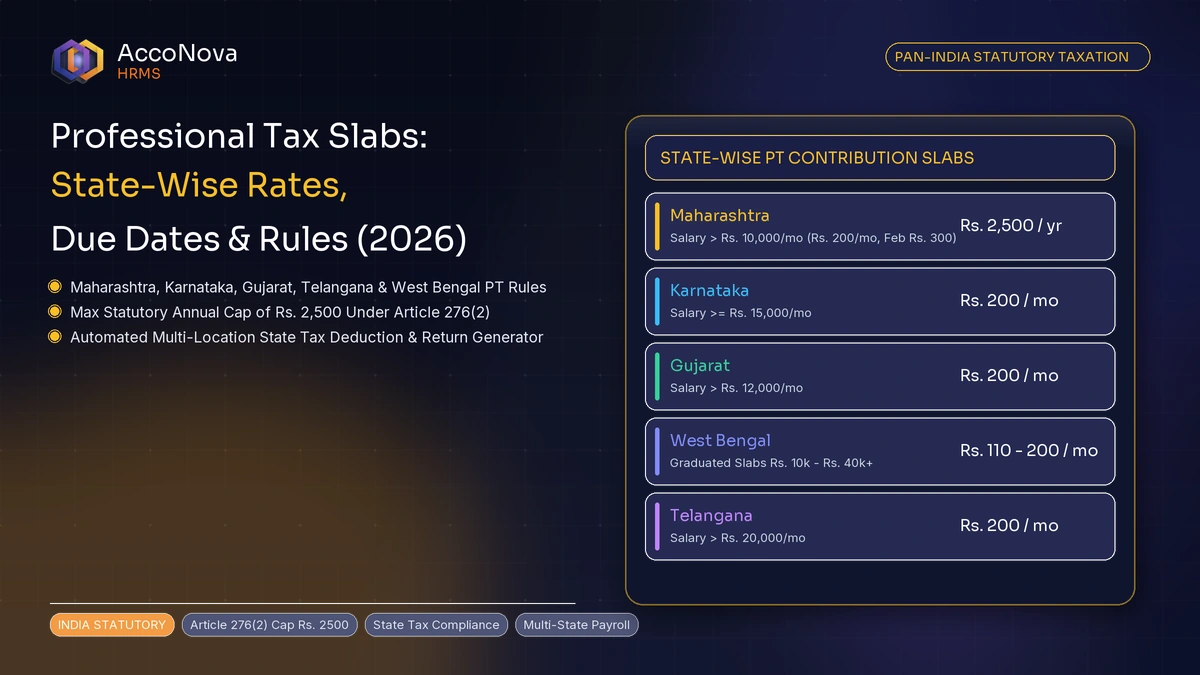
Quick Summary (TL;DR): Professional Tax (PT) in India is a state-level direct tax levied on salaried employees and business professionals under Article 276(2) of the Indian Constitution, subject to a constitutional maximum of ₹2,500 per individual per financial year. While some states like Delhi, Haryana, and Rajasthan levy zero Professional Tax, major industrial states including Maharashtra, Karnataka, Telangana, West Bengal, and Gujarat enforce distinct monthly or half-yearly deduction slabs. Under Section 16(iii) of the Income-tax Act, all PT deducted by an employer is 100% deductible from the employee’s gross taxable salary.
Professional Tax calculation is one of the most common sources of payroll compliance errors for multi-state Indian employers. Because each state legislates its own schedule, deduction thresholds, registration numbers, and filing deadlines, applying a single blanket deduction rule inevitably leads to statutory penalties and incorrect payslips.
Use the state-wise breakdown below to configure your payroll deductions accurately.
State-Wise Professional Tax Slabs (FY 2026-27)
The table below outlines current salary slabs and monthly deduction rates across India’s primary industrial and IT employment hubs.
| State / UT | Monthly Gross Salary Slab | Monthly Deduction Rate | Key Exemption / Special Rules | Official Authority Source |
|---|---|---|---|---|
| Maharashtra | Up to ₹7,500 ₹7,501 to ₹10,000 Above ₹10,000 |
Nil ₹175 ₹200 (₹300 in Feb) |
Women earning up to ₹25,000/month are fully exempt (w.e.f. 2023 amendment). February deduction is ₹300 to reconcile to ₹2,500 annual total. | Maharashtra GST Department |
| Karnataka | Up to ₹25,000 Above ₹25,000 |
Nil ₹200 (₹300 in Feb) |
Salary threshold raised to ₹25,000. Under the 2025 notification, February deduction is ₹300 to balance ₹2,500 per year. | Karnataka Commercial Taxes |
| Telangana | Up to ₹15,000 ₹15,001 to ₹20,000 Above ₹20,000 |
Nil ₹150 ₹200 |
Flat ₹200/month for all staff earning above ₹20k gross. Maximum ₹2,400 per year. | Telangana Commercial Taxes |
| West Bengal | Up to ₹10,000 ₹10,001 to ₹15,000 ₹15,001 to ₹20,000 ₹20,001 to ₹40,000 Above ₹40,000 |
Nil ₹110 ₹130 ₹150 ₹200 |
Progressive 5-tier structure. Due date is 21st of following month for monthly filers. | WB Directorate of Commercial Taxes |
| Gujarat | Up to ₹12,000 Above ₹12,000 |
Nil ₹200 |
Exemption limit for salaried employees is ₹12,000 per month. Above ₹12,000 is flat ₹200/mo. | Gujarat Commercial Tax Dept |
| Andhra Pradesh | Up to ₹15,000 ₹15,001 to ₹20,000 Above ₹20,000 |
Nil ₹150 ₹200 |
Slabs match Telangana; separate AP Commercial Taxes portal registration required. | AP Commercial Taxes |
| Tamil Nadu | Half-yearly slabs: Up to ₹21,000 ₹21,001 to ₹30,000 ₹30,001 to ₹45,000 ₹45,001 to ₹60,000 ₹60,001 to ₹75,000 Above ₹75,000 |
(Half-Yearly) Nil ₹135 ₹315 ₹690 ₹1,025 ₹1,250 |
Levied on a half-yearly basis by local urban bodies (e.g., Greater Chennai Corporation). Maximum ₹2,500/year. | TN Municipal Administration |
| Delhi, Haryana, UP, Rajasthan | All income levels | Nil (No PT Levied) | These states and UTs currently do not levy Professional Tax on salaried employment. | Respective State Notifications |
Interactive Estimation: To test exact salary numbers against specific state rules, use our free State-Wise Professional Tax Calculator.
PTRC vs PTEC: Understanding Employer Registration
Every employer operating in a state that levies Professional Tax must maintain two distinct statutory registrations:
- PTRC (Professional Tax Registration Certificate): Required by the employer to deduct PT from employees’ monthly salaries and remit it to the state commercial tax department.
- PTEC (Professional Tax Enrolment Certificate): Required by the business entity or corporate establishment itself (and directors/partners) to pay tax on its own professional standing, typically ₹2,500 annually.
Failing to register for PTRC while employing workers in a state leads to retrospective assessment and compounding interest penalties ranging from 1% to 2% per month.
Statutory Due Dates and Filing Calendar
Due dates vary significantly based on the number of enrolled employees and state-specific tax laws:
| State | Monthly Challan Payment Due Date | Annual / Periodical Return Due Date |
|---|---|---|
| Maharashtra | Last day of the following month (for employers with monthly liability > ₹100,000); 21st of next month for electronic payments | Form III-B annual return by 31st March |
| Karnataka | 20th of the following month | Form 5 annual return by 30th April |
| Telangana | 10th of the following month | Form V return due on 10th of succeeding month |
| West Bengal | 21st of the following month | Form III annual return by 30th April |
| Tamil Nadu | Half-yearly: 30th September and 31st March | Within 15 days of half-year closing |
Income Tax Deductibility: Section 16(iii) Benefit
Professional Tax is unique among statutory withholdings because it directly lowers taxable salary income.
Under Section 16(iii) of the Income-tax Act, the total amount of Professional Tax paid during the financial year is allowed as an itemized deduction from gross salary. This deduction is allowed under both the Old Tax Regime and the New Tax Regime (Section 115BAC), reducing the employee’s net taxable income before computing tax slabs.
For example, an employee in Karnataka earning ₹10,00,000 gross with ₹2,500 annual PT will have their taxable salary base reduced to ₹9,97,500 before the ₹75,000 standard deduction is applied.
Common Payroll Compliance Mistakes to Avoid
- Applying Home-State Rules to Remote or Hybrid Employees: Professional Tax is legally determined by the employee’s work location / state of posting, not the company’s registered headquarters. If your company is headquartered in Gurugram (Haryana - Nil PT) but your employee works from Bengaluru (Karnataka), Karnataka PT rules strictly apply.
- Forgetting the February Surcharge: In states like Maharashtra and Karnataka, deducting ₹200 in all 12 months totals ₹2,400, leaving an unpaid statutory deficit of ₹100 against the ₹2,500 annual cap. Ensure your payroll engine automatically increases the February deduction to ₹300.
- Overlooking Gender-Specific Exemptions: In Maharashtra, deducting PT from a female employee earning ₹22,000 gross is non-compliant, as women earning up to ₹25,000 per month are legally exempt.
- Treating Unlisted States as Automatically Exempt: Always check official gazettes before assuming zero tax for newer operational centres.
Managing Multi-State PT with AccoNova HRMS
AccoNova’s statutory payroll engine natively incorporates pan-India Professional Tax rules:
- Location-Aware Work-State Mapping: Automatically assigns the appropriate state tax schedule based on employee branch assignments.
- Automated February Adjustments: Automatically adjusts February deductions in Maharashtra and Karnataka.
- Exemption Engine: Honors female exemptions in Maharashtra and disability allowances across all states.
- Form 16 Sync: Directly reconciles Section 16(iii) line items on annual tax computation statements.
Explore how AccoNova automates multi-state payroll deductions on our Payroll Management Software page, or compare plan options on the Pricing Page.