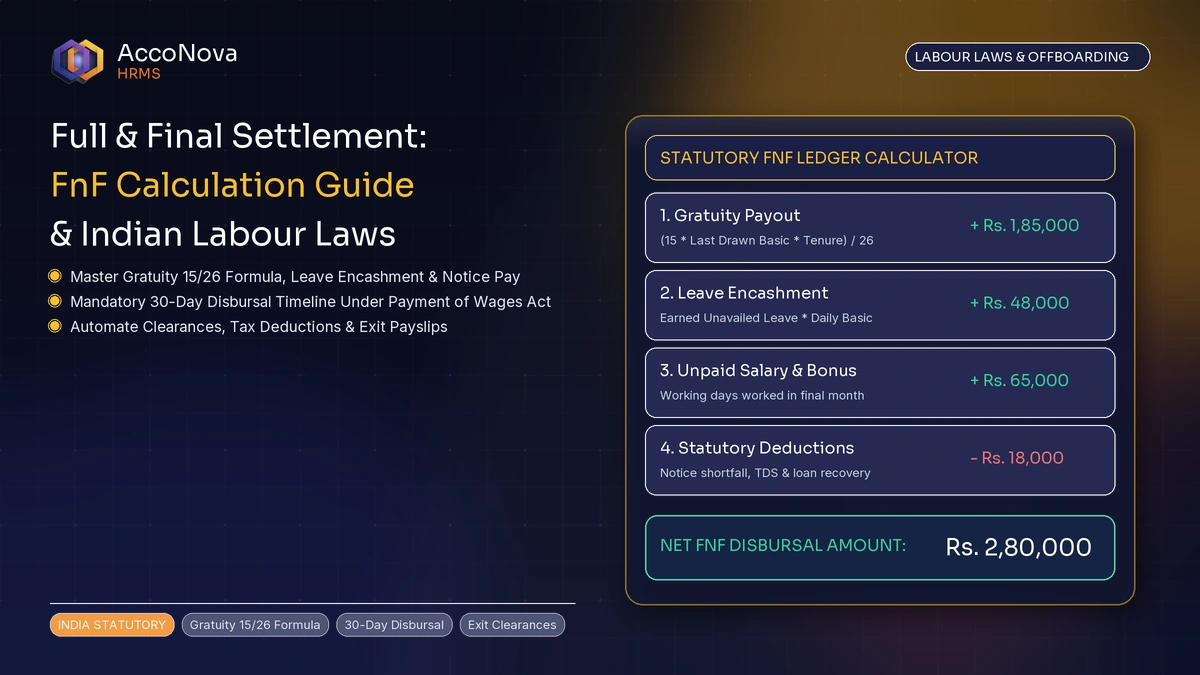
Quick Summary (TL;DR): A Full and Final (FnF) settlement is the formal statutory accounting process conducted when an employee exits an organization (resignation, termination, or retirement). Under Indian labour regulations—including the Payment of Wages Act and the Code on Wages—employers must reconcile earned salary for days worked, accrued leave encashment, statutory gratuity (if service exceeds 5 years), and annual bonus adjustments against company recoveries (notice shortfall, unreturned assets, or loan balances). Standard statutory practice mandates clearing all dues within 30 to 45 days, with the Code on Wages establishing a 2-working-day timeline for final wages following separation.
Handling an employee’s exit cleanly is critical for maintaining organizational reputation and avoiding labour dispute notices. A delayed or inaccurate FnF settlement damages employer branding and can trigger statutory non-compliance penalties from regional labour commissioners.
Here is the complete, practical guide to calculating each component of an FnF settlement in India.
The 6 Core Components of an FnF Settlement
A legally defensible FnF statement consists of payable earnings and authorized deductions clearly separated into line items:
Net FnF Payable = (Earned Salary + Leave Encashment + Gratuity + Unpaid Bonuses/Reimbursements)
- (Notice Period Shortfall + Asset/Loan Deductions + Statutory Taxes)| Component | Description | Tax Treatment |
|---|---|---|
| 1. Unpaid Earned Salary | Salary for days worked in the final month up to the Last Working Day (LWD). | Fully taxable under normal income tax slabs |
| 2. Leave Encashment | Compensation for unavailed Earned Leave (EL) or Privilege Leave (PL). | Tax-exempt up to ₹25,00,000 under Section 10(10AA) for private-sector staff |
| 3. Statutory Gratuity | Lumpsum benefit for employees with at least 5 years of continuous service. | Tax-exempt up to ₹20,00,000 under Section 10(10) of the Income-tax Act |
| 4. Variable Pay & Bonus | Pro-rata statutory bonus under the Payment of Bonus Act (minimum 8.33%). | Taxable in the year of receipt |
| 5. Notice Period Recovery | Deduction if the employee exits early without serving full contractual notice. | Deducted from gross settlement |
| 6. Statutory Deductions | Final PF (12%), PT, and TDS withheld on net taxable income. | Remitted in standard monthly returns |
1. Calculating Earned Salary
Earned salary represents remuneration from the 1st day of the exit month until the employee’s Last Working Day (LWD), minus any Loss of Pay (LOP) days:
$$\text{Earned Salary} = \left( \frac{\text{Monthly Gross Salary}}{\text{Total Days in Month}} \right) \times \text{Payable Working Days}$$
Example: An employee earning ₹60,000 monthly gross exits on the 18th of a 30-day month with zero LOP days.
Earned Salary = $(₹60,000 / 30) \times 18 = ₹36,000$.
2. Calculating Leave Encashment
Under Indian Shops and Establishments Acts and the Factories Act, accumulated Earned Leave (EL) or Privilege Leave (PL) must be encashed upon separation. Casual Leave (CL) and Sick Leave (SL) are non-encashable and lapse automatically upon exit.
$$\text{Leave Encashment} = \left( \frac{\text{Basic Salary} + \text{Dearness Allowance (DA)}}{30} \right) \times \text{Unavailed EL Balance}$$
Tax Exemption: Under Section 10(10AA) of the Income-tax Act, leave encashment received by non-government employees at retirement or resignation is exempt up to a lifetime ceiling of ₹25,00,000 (raised from ₹3 lakh by the CBDT).
3. Statutory Gratuity Calculation
Under the Payment of Gratuity Act, 1972, every establishment employing 10 or more workers must pay gratuity to employees who have completed at least 5 years of continuous service.
The Statutory Formula:
$$\text{Gratuity} = \frac{15 \times \text{Last Drawn (Basic} + \text{DA)} \times \text{Completed Years of Service}}{26}$$
- 15: Represents 15 days of wages per completed year.
- 26: The standard number of working days in a month (excluding Sundays).
- Service Rounding: If service exceeds 6 months in the final year (e.g., 5 years and 7 months), it is rounded up to 6 completed years.
Example: An employee with 6 years of service and a last drawn Basic + DA of ₹40,000: $$\text{Gratuity} = \frac{15 \times ₹40,000 \times 6}{26} = \frac{₹36,00,000}{26} \approx ₹1,38,461$$
Under Section 10(10) of the Income-tax Act, gratuity received under the Act is exempt from income tax up to ₹20,00,000.
4. Notice Period Recovery vs Payout
- Notice Payout (Employer Terminates): If an employer terminates employment without requiring the employee to serve notice, the employer must pay salary for the full unserved notice period.
- Notice Recovery (Employee Resigns Early): If an employee resigns with a 60-day notice requirement but exits after 30 days without manager waiver, the employer is legally entitled to recover the remaining 30 days of salary. Recovery is typically calculated on Basic or Gross pay as stipulated in the formal appointment letter.
5. End-to-End FnF Settlement Workflow & SOP
To ensure zero compliance friction, follow this standard operational checklist:
- Resignation & LWD Approval: HR and reporting manager accept resignation in the HRMS and lock the official Last Working Day.
- Departmental Clearances:
- IT & Assets: Return of laptop, access tokens, SIM cards, and company hardware.
- Finance: Settlement of outstanding corporate credit cards, travel imprests, and salary advances.
- HR / Admin: Cancellation of ID cards, health insurance de-enrollment, and NDA sign-off.
- Attendance & Leave Reconciliation: Finalize biometric/GPS attendance regularizations and compute exact unavailed leave balances.
- Statement Generation: The payroll team prepares the itemized FnF worksheet and verifies Section 192 TDS deductions.
- Employee Acknowledgement: The itemized statement is shared with the employee for review and sign-off.
- Payment & Relieving Letter: Disburse final funds via NEFT/RTGS, issue the formal Relieving Letter, Service Certificate, and update the exit date on the EPFO employer portal.
Managing Exit Workflows with AccoNova HRMS
AccoNova’s employee lifecycle engine automates the entire separation pipeline:
- Digital Asset Tracking: Links hardware assets directly to employee profiles, preventing clearance approval until all devices are returned.
- Automated Gratuity & Leave Computations: Eliminates manual spreadsheet errors by automatically applying statutory formulas.
- Automated EPFO Exit Seeding: Flags the date of exit for direct sync into monthly EPFO ECR returns.
Learn more on our Employee Management Software and Payroll Management pages.