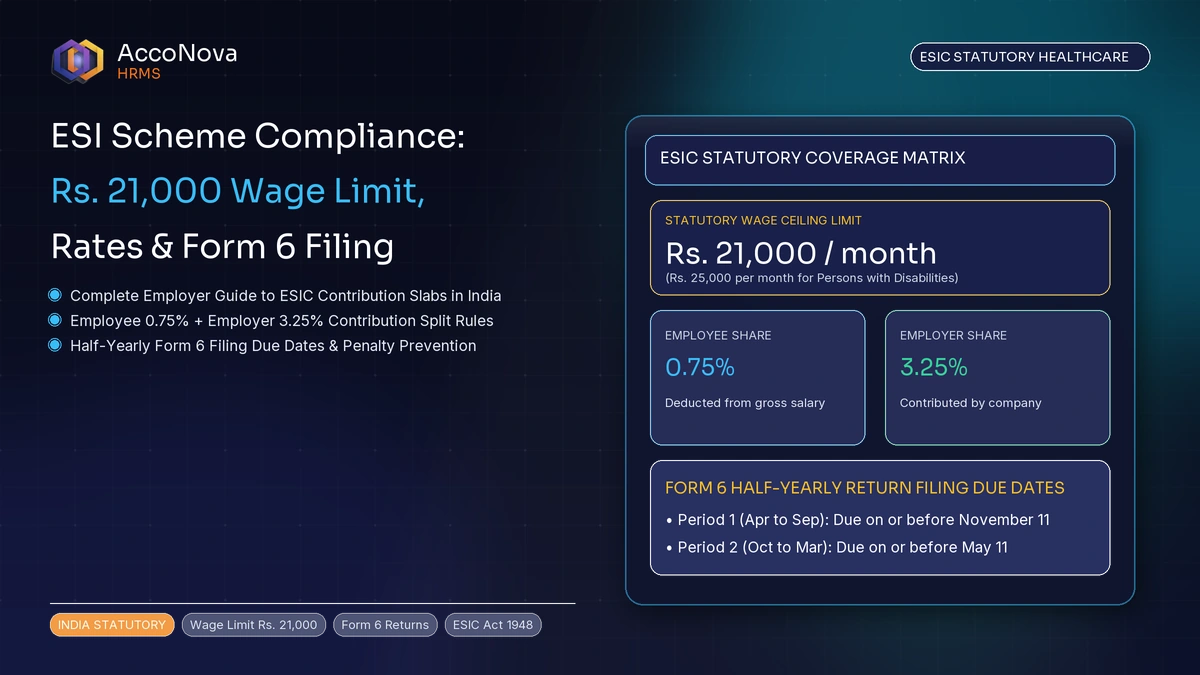
Quick Summary (TL;DR): The Employees’ State Insurance (ESI) scheme, governed by the ESI Act of 1948, is an integrated social security framework providing healthcare, maternity, sickness, and cash benefits to Indian workers. It is mandatory for non-seasonal factories and commercial establishments employing 10 or more persons located in notified geographical areas. The statutory wage ceiling for ESI coverage is ₹21,000 per month (₹25,000 for employees with disabilities). Effective 1 July 2019, the reduced statutory contribution rates are 0.75% for the employee and 3.25% for the employer (total 4.00%). Employers must file returns and remit contributions by the 15th of the succeeding month on the ESIC portal.
Navigating ESI compliance requires understanding specific administrative nuances—most notably the distinction between contribution and benefit periods, and the rule governing mid-period salary increments.
Here is the complete operational guide to managing ESI payroll deductions and statutory filings.
ESI Statutory Applicability, Wage Ceiling, and Contribution Rates
Under the Employees’ State Insurance Act, 1948, coverage criteria and contribution rates are defined as follows:
| Parameter | Statutory Rule | Notes |
|---|---|---|
| Establishment Threshold | 10 or more workers (in most states) | Applies to factories, shops, IT/ITES firms, hotels, and educational institutions. |
| Standard Wage Ceiling | ₹21,000 per month (Gross Pay) | Calculated on total monthly gross salary excluding annual bonus. |
| Disability Wage Ceiling | ₹25,000 per month | Higher threshold applicable for employees with certified physical disabilities. |
| Employee Contribution | 0.75% of Gross Wages | Deducted directly from the employee’s monthly payslip. |
| Employer Contribution | 3.25% of Gross Wages | Paid entirely by the employer as a corporate statutory overhead. |
| Total Contribution | 4.00% of Gross Wages | Remitted monthly via the unified ESIC challan. |
| Daily Wage Exemption | Up to ₹176 per day | Employees earning an average daily wage up to ₹176 are exempt from the employee share (employer still pays 3.25%). |
Contribution Periods vs. Benefit Periods
ESI operates on two distinct six-month Contribution Periods, each linked to a corresponding Benefit Period during which the employee can claim medical, cash, or sickness assistance:
| Contribution Period (Deductions Made) | Corresponding Benefit Period (Benefits Availed) | Return Filing Deadline |
|---|---|---|
| 1st April to 30th September | 1st January to 30th June of the following year | 11th November |
| 1st October to 31st March | 1st July to 31st December of the following year | 11th May |
The Critical “Continuation Rule” (Mid-Period Salary Hike)
One of the most frequently misunderstood statutory provisions is Regulation 31 of the ESI (General) Regulations, 1950:
If an employee’s monthly gross wage is ₹20,000 at the start of a contribution period (e.g., in April) and they receive an increment to ₹24,000 in July (crossing the ₹21,000 ceiling), the employer MUST continue deducting ESI contributions until the end of that contribution period (30th September).
The employee only exits the ESI coverage scheme at the start of the next contribution period (1st October). Stopping deductions mid-cycle in July is an explicit statutory violation.
Core Statutory Benefits Provided Under the ESI Scheme
When covered under ESIC, employees and their registered dependents receive:
- Medical Benefit: Full, cashless outpatient and inpatient medical care across ESIC dispensaries and empanelled tertiary hospitals from day one of insurable employment.
- Sickness Benefit: Cash compensation equal to 70% of average daily wages for up to 91 days in any two consecutive benefit periods.
- Maternity Benefit: 100% of average daily wages for 26 weeks for confinement/childbirth (with extensions up to 12 weeks for adoptions/surrogacy).
- Disablement Benefit: 90% of wages paid monthly for temporary disablement arising from an employment injury for the entire duration of incapacity.
- Dependent’s Benefit: 90% of daily wages paid as a monthly pension to surviving dependents in the event of an employment-related death.
Monthly Return Filing & Challan Remittance SOP
- Calculate Monthly Deductions: Compute 0.75% and 3.25% on total gross wages for all eligible employees earning ₹21,000 or below.
- Log into ESIC Portal: Access the employer login at
esic.gov.in. - Upload Monthly Contribution Details: Upload employee-wise wage and deduction records via the monthly excel/csv return tool.
- Generate Monthly Challan: Review total employee ($₹$) and employer ($₹$) figures and generate the 17-digit payment challan.
- Remit Payment Before the 15th: Complete online payment by the 15th of the succeeding month to avoid 12% p.a. interest penalties under Section 39(5)(a).
- Maintain Form 6 Register: Retain the statutory Form 6 Register of Employees with IP numbers, wage breakdowns, and attendance days for inspection audits.
Managing ESIC Workflows with AccoNova HRMS
AccoNova’s statutory payroll engine natively automates ESIC management:
- Automated Ceiling Filtering: Evaluates ₹21,000 wage thresholds dynamically across salary runs.
- Enforced Continuation Logic: Implements Regulation 31 logic, ensuring mid-period increments do not break statutory cycles prematurely.
- 1-Click ESIC Monthly Upload File: Exports bulk monthly upload templates formatted to official ESIC portal standards.
Explore automated statutory payroll on our Payroll Management Software page, or compare plan inclusions on our Pricing Page.